Electricity Tariffs Are Rising Again in Sri Lanka: How an Energy Audit Pays Back
By Vibhawa Editorial Team · Vibhawa Consultants · Updated 18 October 2026
Key takeaways
- There was no tariff revision in Q1 2026. PUCSL approved an overall increase of about 10% from 1 April (8% to 14.4% by category), below the 13.56% CEB asked for.
- An 18% increase followed on 11 May for large-scale industry, GP-2 and GP-3 general purpose users, government institutions and domestic users above 180 units a month. Small and medium-scale industry was exempt.
- For Q4, the National System Operator has requested 2.88%. PUCSL’s preliminary review put it at 1.46%, and comments are open until 5 November 2026.
- Larger connections also pay a demand charge on peak kVA, so poor power factor and uncontrolled peaks raise the bill even when consumption is flat.
- An energy audit finds where the money goes. Savings depend on the site, so we report them finding by finding, not as a headline percentage.
What changed in Sri Lanka’s electricity tariffs in 2026
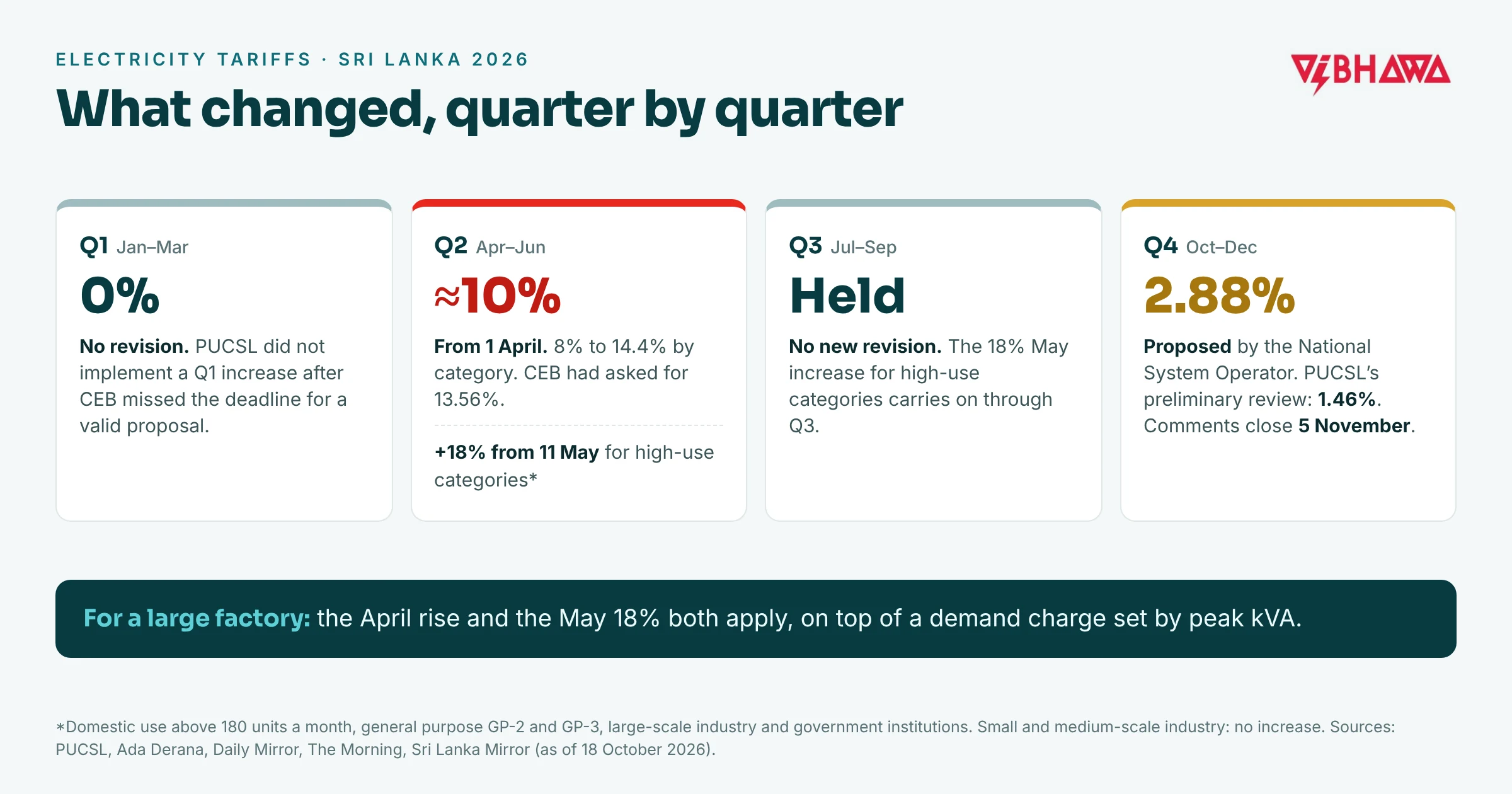
Tariffs are reviewed quarterly by the Public Utilities Commission of Sri Lanka (PUCSL). This is what happened in each quarter of 2026:
| Period | Change | Detail | Source |
|---|---|---|---|
| Q1 (Jan–Mar) | No revision | PUCSL decided not to implement a revision after CEB failed to submit a valid proposal on time. | Ada Derana |
| Q2 (from 1 Apr) | ≈10% overall | 8% to 14.4% depending on category. CEB had requested 13.56%. | The Morning, Ada Derana |
| From 11 May | 18% | For domestic use above 180 units a month, GP-2 and GP-3, large-scale industry and government institutions, covering the rest of Q2 and all of Q3. Small and medium-scale industry: no increase. About 95% of consumers were not affected, helped by a Rs. 15 billion government subsidy. | Daily Mirror, Ada Derana |
| Q3 (Jul–Sep) | No new revision | PUCSL said lower fuel prices would be reflected at the next scheduled revision. | The Morning |
| Q4 (Oct–Dec) | 2.88% proposed | Requested by the National System Operator. PUCSL’s preliminary review put it at 1.46%. Written comments until 5 November, then provincial oral consultations before a final decision. | Sri Lanka Mirror |
Official tariff decisions and consultation papers are published on the PUCSL website.
Why tariffs keep moving
Sri Lanka prices electricity on a cost-reflective basis. In a December 2024 Sunday Times report on tariff decisions, our founder Nadeera Wijesinghe, a chartered electrical engineer, explained the principle:
Sri Lanka’s Electricity Act mandates a cost-reflective tariff methodology: the costs of generating, transmitting and distributing electricity are passed on to consumers, with PUCSL regulating to prevent unreasonable expenses.
That is why tariffs follow fuel prices, rainfall and demand. In 2026, higher fuel prices and lower-than-expected hydro generation pushed generation costs up, and the tariff followed. A facility cannot control those inputs, but it can control how much electricity it draws, when it draws it, and how efficiently.
Why industrial and commercial sites feel it most
Larger electricity users are billed differently from homes, and the structure works against an inefficient site in three ways:
Power factor: the cheapest saving most sites miss
Because the demand charge is billed in kVA, power factor feeds straight into the bill. For the same useful load in kW, a lower power factor means a higher kVA demand:
| Useful load | Power factor | Maximum demand billed |
|---|---|---|
| 800 kW | 0.80 | 1,000 kVA |
| 800 kW | 0.95 | 842 kVA (about 16% less) |
Correcting power factor, usually with a properly sized and maintained capacitor bank, is often one of the fastest payback items an audit finds. The bank also needs checking: failed capacitor steps or a wrongly set controller quietly undo the saving.
What an energy audit finds
An energy audit measures how and when a facility actually uses electricity, then identifies where it is paying more than it needs to. Our audits are carried out by chartered electrical engineers with calibrated power analysers, under our ISO 9001:2015 quality management system. A typical audit looks at:
Each finding is reported with its estimated cost and saving, so you can act on the best ones first. Findings can then be logged in WRENS, our QR-based asset condition recording system, so each asset’s condition and the actions taken are tracked from one audit to the next.
Our energy audit work
More of our energy studies are listed on our projects page.
How much can an energy audit save?
There is no honest universal figure. The saving depends on operating hours, tariff category, maximum demand, the age and loading of equipment, and what has already been done. A site that has never had a formal audit usually has more low-cost, fast-payback findings than one that has already dealt with the obvious items. That is why we price each finding separately rather than promise a percentage up front.
Act before the next revision
The Q4 proposal is still under consultation, and tariffs will be reviewed again next year. Large consumers can also send their views to PUCSL before 5 November. The sites that gain most are the ones that act before the next increase, not after it. See our energy efficiency services.
Get an energy audit scoped to your site
Send us a recent electricity bill and tell us what the site does. We’ll tell you where to look first and what an audit would cover.
Frequently asked questions
Why did electricity tariffs increase in Sri Lanka in 2026?
Sri Lanka uses a cost-reflective tariff method, so the cost of generating and supplying electricity is passed on to consumers. In 2026, higher fuel prices, lower-than-expected hydro generation and a projected revenue shortfall led PUCSL to approve an overall increase of about 10% from 1 April and a further 18% for high-use categories from 11 May.
Does the 18% increase apply to my factory?
It applies to large-scale industry, general purpose categories GP-2 and GP-3, government institutions and domestic users above 180 units a month. Small and medium-scale industry was not given the 18% increase. Check the category on your electricity bill.
Will electricity tariffs rise again in the fourth quarter of 2026?
Possibly. The National System Operator has asked PUCSL for a 2.88% increase for October to December, and PUCSL’s preliminary review put it at 1.46%. Public comments are open until 5 November 2026, and the final decision follows provincial consultations.
How does power factor affect my electricity bill in Sri Lanka?
For larger connections, CEB’s demand charge is billed on maximum demand in kVA, not kW. A low power factor raises the kVA drawn for the same useful load, so it raises the demand charge. A site drawing 800 kW at 0.80 power factor has a demand of 1,000 kVA; at 0.95 it is about 842 kVA, roughly 16% less.
What does an energy audit include?
An energy audit measures how and when a facility uses electricity, then finds where it is wasted: maximum demand and power factor, motors and compressors, compressed air leaks, HVAC and lighting schedules, distribution losses and power quality. The report ranks each finding by cost and saving so you can act on the best ones first.