June 25, 2026

Build the network once in software, and it answers the questions that otherwise get settled by argument: how much energy is released if that board faults, which breaker should clear it, whether your switchgear is still rated for the fault level, and where the voltage is quietly collapsing. Modelled in ETAP and certified by Chartered Electrical Engineers, for clients in Sri Lanka, the Maldives, Australia, Vietnam, Qatar and the UK.
Why the studies are scoped together.
The expensive part of a power system study is not the study. It is building and validating the model — gathering drawings that are rarely current, confirming equipment ratings, getting the utility's fault level, and establishing what was actually installed rather than what was specified.
Once that model exists and is trusted, the studies that run on it are comparatively cheap. A short circuit study is a prerequisite for arc flash; arc flash and coordination share the same protective device data; load flow uses the same network. Clients who commission them one at a time, years apart, pay for the model three times.
So we scope them together wherever it makes sense, and we keep the model afterwards. When you add a transformer or a production line, your network is re-studied from what already exists.
Incident energy at every working position, the PPE that follows from it, and the labels your switchroom needs. Calculated to IEEE 1584-2018.
Arc flash study →Relay and breaker settings that clear a fault at the nearest device instead of tripping the incomer — delivered as time–current curves and a settings schedule.
Prospective fault current at every bus and board, to IEC 60909. It checks whether your switchgear is still rated for the fault it would have to interrupt — and every other study is built on it.
How real and reactive power move through the network under the loads you actually run: voltage at the far end of long feeders, transformers and cables near their limit, and the losses you pay for every hour.
Harmonic distortion from drives, rectifiers, UPS and inverter-based generation, checked against IEEE 519 limits, with filter sizing where the limits are exceeded.
Voltage dip and acceleration time when large motors start — direct-on-line, star-delta or soft-start — so the rest of the plant rides through it.
How generators and large motors behave through a fault or a sudden loss of supply, for plants with on-site generation.
Surge arrester selection and placement against the insulation levels of the equipment it protects.
Cables checked or sized for current capacity, voltage drop and short-circuit withstand, in the same model as everything else.
An independent review of a study someone else produced — most often one done by the contractor who built the installation.
Been asked for a study not named here? Send us the requirement and we will tell you whether it is one we do.
The two foundation studies, which most clients first meet as part of something else.
Short circuit study. Switchgear specified fifteen years ago, on a network that has since gained a larger transformer and a second incomer, may no longer be rated for the fault it would have to interrupt. That is a rupture risk, not a nuisance. The study calculates prospective fault current at every bus to IEC 60909 and checks it against each device's breaking capacity. On an existing installation we can also measure prospective fault current on site, up to 50 kA, during an electrical safety audit — the model and the measurement checking each other.
Load flow study. The study to run before you add load — a new production line, a chiller plant, an EV charging bank — because it answers whether the existing infrastructure will carry it, and if not, what the cheapest intervention is. Motor starting sits alongside it where large machines are involved.
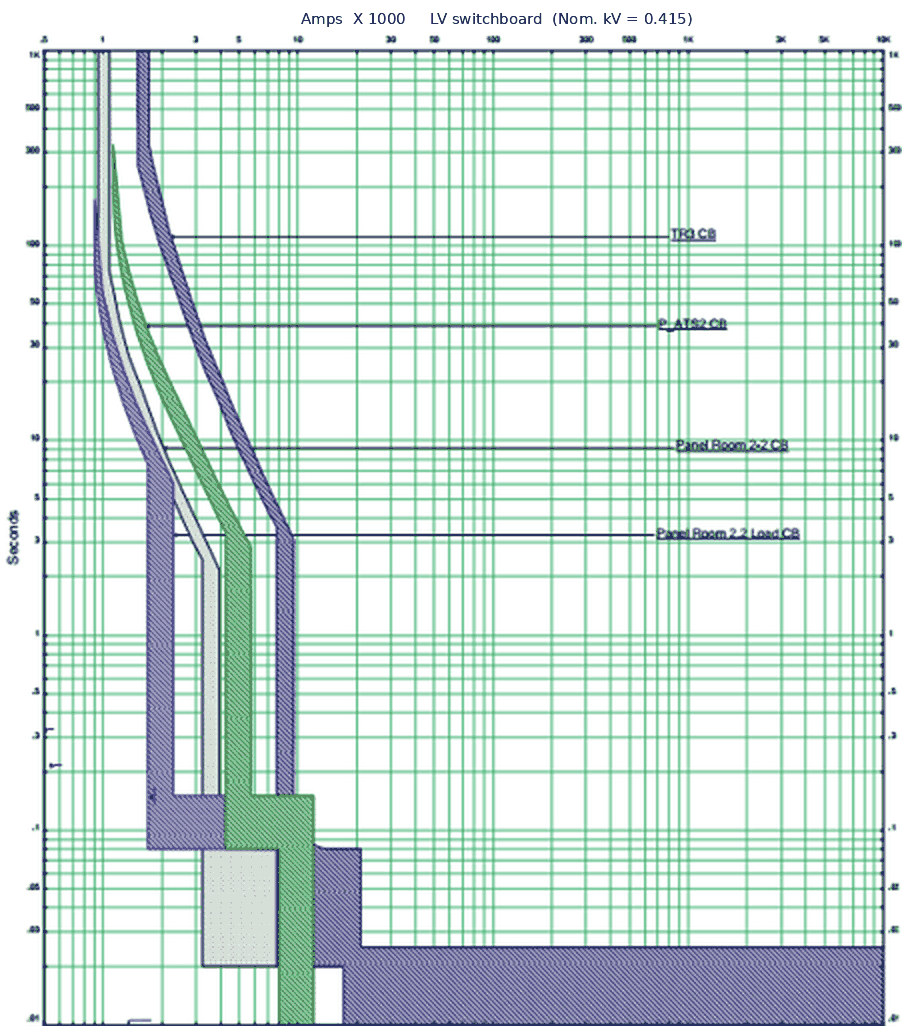
Time–current curves from one of our coordination studies, with the client's details removed. Each band is a protective device; the gaps between them are what make the nearest breaker trip first.
ETAP modelling of the construction-phase distribution system for the 2,200 MW scheme, across more than 100 substations.
Read the project →Arc flash and protection coordination studies in ETAP for the plant's distribution system.
Two 2.5 MVA compact substations for 12 EV chargers — ETAP model, arc flash study and Chartered Engineer certification.
Power system studies behind a 3 MW 11 kV / 400 V offshore and onshore substation, delivered for SWIMSOL.
Our Maldives work →Offshore and compact substation design with ETAP protection coordination and arc flash modelling.
Arc flash study for the Sri Lankan operation, alongside five years of electrical safety audits.
Read the case →Published here because the usual cause of a delayed study is not the engineering — it is three weeks of chasing data nobody told you to prepare.
Studies are built from the data on the left, so there is no mobilisation, no travel cost and no site disruption — and no reason a plant in Melbourne, Malé or Doha is harder to serve than one in Colombo. Where a record is missing, we tell you exactly what to check.
An engineering analysis of an electrical network built as a computer model — in our case in ETAP — to calculate fault levels, power flows, protection behaviour and arc flash hazard. The most common are short circuit, load flow, protection coordination and arc flash studies, usually scoped together because they share the same model.
For a large industrial facility, two to four weeks from complete data, depending on the size and complexity of the system. Smaller installations are faster. The clock starts when the data is in, which is why we are specific about what we need.
No. Studies are built from drawings, nameplate data and device settings, so there is nothing to schedule around your operations and no travel to pay for. Distance is not a factor — we deliver to Australia, Vietnam, Qatar and the Maldives on the same terms as Colombo.
No blanket requirement exists. In practice the pressure comes from a multinational parent's HSE standard, an insurer, a client audit, or a utility before it approves a connection. Facilities owned from, or exporting to, Australia, the EU and the US are asked most often.
Yes, and it is a common scope — particularly where the study was produced by the contractor who also built the installation. Independent review is the point of us being independent.
It is normal rather than exceptional. We work through what you have, identify the gaps, and give your team a specific list of what to verify — nameplate readings, device settings, cable runs. It adds time; it does not stop the study.
ETAP, licensed to Vibhawa since 2020 and currently on version 24.0.3. You can verify the licence on ETAP's public users list; a copy of the licence certificate is available on request.
A single-line diagram and your supply details are enough for a price. Tell us who asked for the study and we will scope it to what they will accept.
Electrical Testing
Infrared Thermography
Electrical Consultancy
Electrical Design
Compliance Monitoring
Other Services
© 2025 Vibhawa Consultants. Site By Remnis Global