

November 11, 2026

On-site testing of Type 1, Type 2 and Type 3 surge protective devices (SPDs) — the surge arresters in your distribution boards. We verify every varistor, gas discharge tube and line-to-earth insulation path, not just the indicator window. Sri Lanka and the Maldives.
Typical Type 2 SPD · MOV L–N · GDT N–PE
SPD testing, also called surge arrester testing, is a dead test that confirms a surge protective device is present, correctly rated and still working. A current-limited insulation resistance tester applies a controlled DC voltage across each terminal pair. We read the voltage at which the metal oxide varistor (MOV) clamps and the gas discharge tube (GDT) strikes, then check line-to-earth insulation below activation. Each result is compared with the device's own ratings, Uc and Up, to give pass, fail or replace.
Surge arresters wear out. Every surge a varistor absorbs causes a little permanent damage, and as it ages its leakage current at normal voltage rises. A worn MOV conducts slightly all the time, heats up and can run away thermally inside the board.
Most SPDs carry a thermal disconnector and an end-of-life window to guard against this. But once that disconnector operates, that path has no surge protection until the module is replaced — and some faults never show on the front of the device.
Testing shows which SPDs are protecting your installation, which are degrading, and which have already stopped working.
Single-phase and three-phase low-voltage SPDs to BS 7671 and IEC 61643-11: Type 1 at the main board, Type 2 at distribution boards and Type 3 close to sensitive equipment.
Make, model, Type, Uc, Up and connection type recorded; end-of-life indicator, overheating, terminations, conductor identification and the backup fuse or MCB checked.
Each phase to neutral. The voltage should rise and settle at a stable clamp inside the expected window. Phases are compared for uneven degradation.
Neutral to earth. The spark gap strikes and recovers, so the readings jump about. That instability is the correct signature of a working GDT.
Each phase to earth at 250–500 V, below activation. A low reading reveals a leakage path that the component tests cannot see.
Illustrative figures. For every real SPD the window is calculated from that device's own Uc and Up.
| Path | Healthy | Problem |
|---|---|---|
| L–N (MOV) | Stable clamp inside window | Below window: degraded. No clamp: open or disconnector operated |
| N–PE (GDT) | Erratic strike inside window | Below window: degraded. No strike: open |
| L–PE | >999 MΩ below activation | Low reading: leakage path |
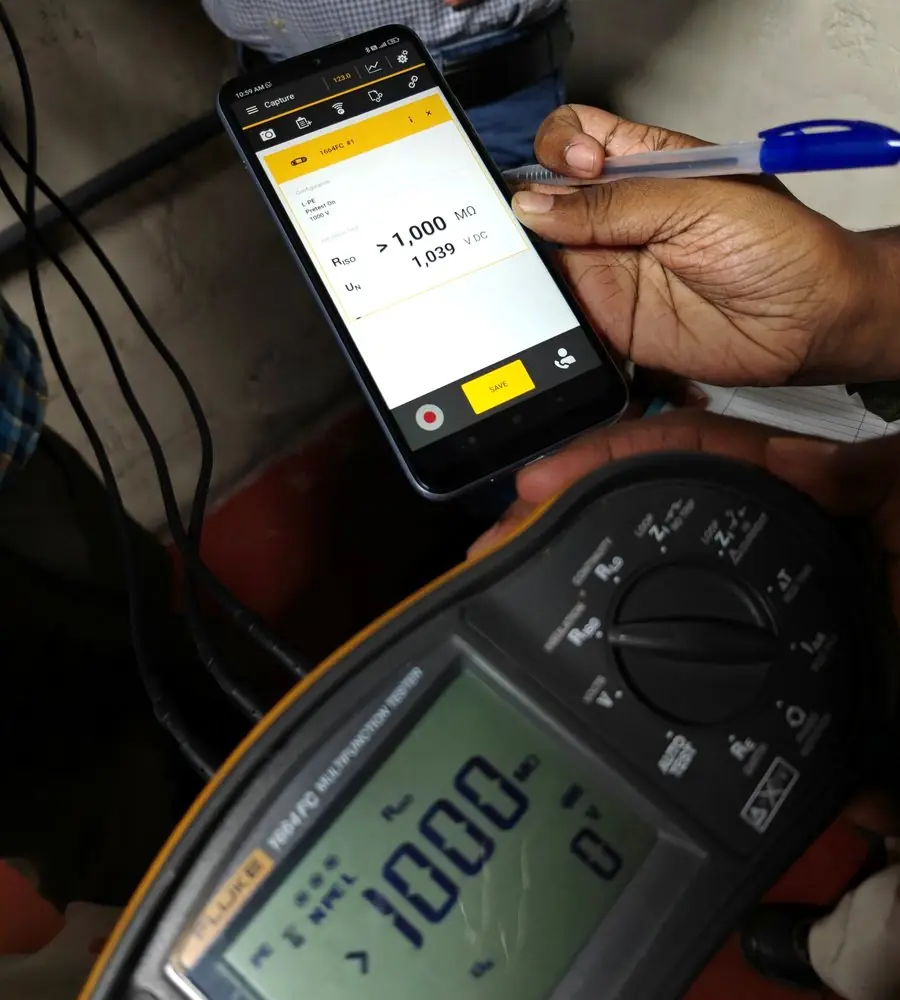
We test SPDs with the Fluke 1664 FC, a calibrated multifunction installation tester with insulation test ranges up to 1000 V DC. Its insulation test current is limited, so it can probe a surge arrester's varistor and gas discharge tube without damaging them, and it shows the actual test voltage — the reading SPD verification depends on.
Results are captured wirelessly in the Fluke Connect app as each test is made, so the voltage and resistance in your report are the values the instrument measured. A calibrated insulation resistance tester is carried alongside for confirmation.
On site, "lightning arrester" and "surge arrester" usually mean the surge protective device in the board. This service covers low-voltage SPDs only.
The DIN-rail surge arrester in a main or distribution board — Type 1, 2 or 3, single-phase or three-phase. Tested on this page: MOV, GDT and line-to-earth checks.
Air terminals, down conductors and earth electrodes on the building. Tested to IEC 62305 in our lightning protection and earthing surveys — SPDs are its internal half.
Field testing confirms that each SPD is present, correctly rated and that its active components and insulation are working. It is defensible confirmation of SPD condition at your installation.
It does not reproduce full surge-withstand (impulse) type testing. That needs a surge generator and is a manufacturer's type-test activity, not a field test.
We say this plainly so you know exactly what our report certifies.
SPD checks added to periodic inspection and testing of industrial, commercial and hotel installations.
Electrical safety audits →SPDs tested alongside earthing and lightning protection surveys to IEC 62305.
Lightning protection →Pre-commissioning checks that new SPDs are correctly selected, rated and wired before energisation.
Testing & commissioning →Where an SPD has failed or a board has been damaged, testing the remaining devices establishes their condition and helps identify the cause.
Incident investigation →A targeted check of SPDs at the main and distribution boards after a nearby strike or a major supply disturbance.
Request a check →AC-side SPDs at inverters and distribution boards checked as part of a solar health check.
Solar health check →Not covered here? Send us the SPD make and model and the number of boards, and an engineer will reply.
With the circuit isolated and proved dead, a current-limited insulation resistance tester is connected across each terminal pair of the SPD in turn: line to neutral for the metal oxide varistor (MOV), neutral to earth for the gas discharge tube (GDT), and line to earth for insulation. The voltage at which each component clamps or strikes is compared with the window calculated from the device's own ratings, √2 × Uc to Up ÷ 2.
Check the end-of-life indicator, then measure. A healthy MOV gives a stable clamp voltage inside the expected window; a healthy GDT gives erratic readings as its spark gap strikes and recovers; and the line-to-earth path reads above 999 MΩ below activation. A clamp below the window, no clamping at all, or a low line-to-earth reading means the device is degraded, open or leaking and should be replaced.
No. The indicator only shows whether the thermal disconnector has operated. A varistor that has degraded but not yet overheated, or a hidden leakage path from line to earth, can sit behind a green window. Only a test shows these.
At every periodic inspection and test of the installation. For industrial premises we recommend testing every year, and also after a nearby lightning strike or a major supply disturbance.
Not always. In low-voltage installations, "lightning arrester" and "surge arrester" are often used for the surge protective device in the distribution board, which is what this page covers. This service covers low-voltage SPDs only. The term is sometimes also used for the air terminals of a lightning protection system, which we test in our lightning protection and earthing surveys.
Yes, if the insulation tester limits its output current to below 2 mA, as the Fluke 1664 FC we use does. "Megger" is the common name; the correct term is insulation resistance testing. The key reading is the indicated test voltage when the component activates, not only the resistance.
Yes. It is a dead test, so each board is isolated for a short period while its SPDs are tested. We plan the sequence with your team to keep the outage short.
The tester's current is limited below 2 mA, far too low to harm an industrial SPD. Voltage-sensitive equipment downstream is disconnected, or the SPD module is removed, before any test voltage is applied.
It proves the SPD is present, correctly rated and that its components and insulation are working. Full surge-withstand (impulse) testing needs a surge generator and is carried out by the manufacturer at type-test stage, not in the field.
Tell us the site, the number of boards and, if you have them, the SPD make and model. We'll come back with a scope and price.
At Vibhawa, we offer state-of-the-art Electrical Consultancy, Testing, Condition Monitoring and Engineering Services designed for the needs of tomorrow’s world.
Electrical Testing
Infrared Thermography
Electrical Consultancy
Electrical Design
Compliance Monitoring
Other Services

© 2026 Vibhawa Consultants. Site By Remnis Global